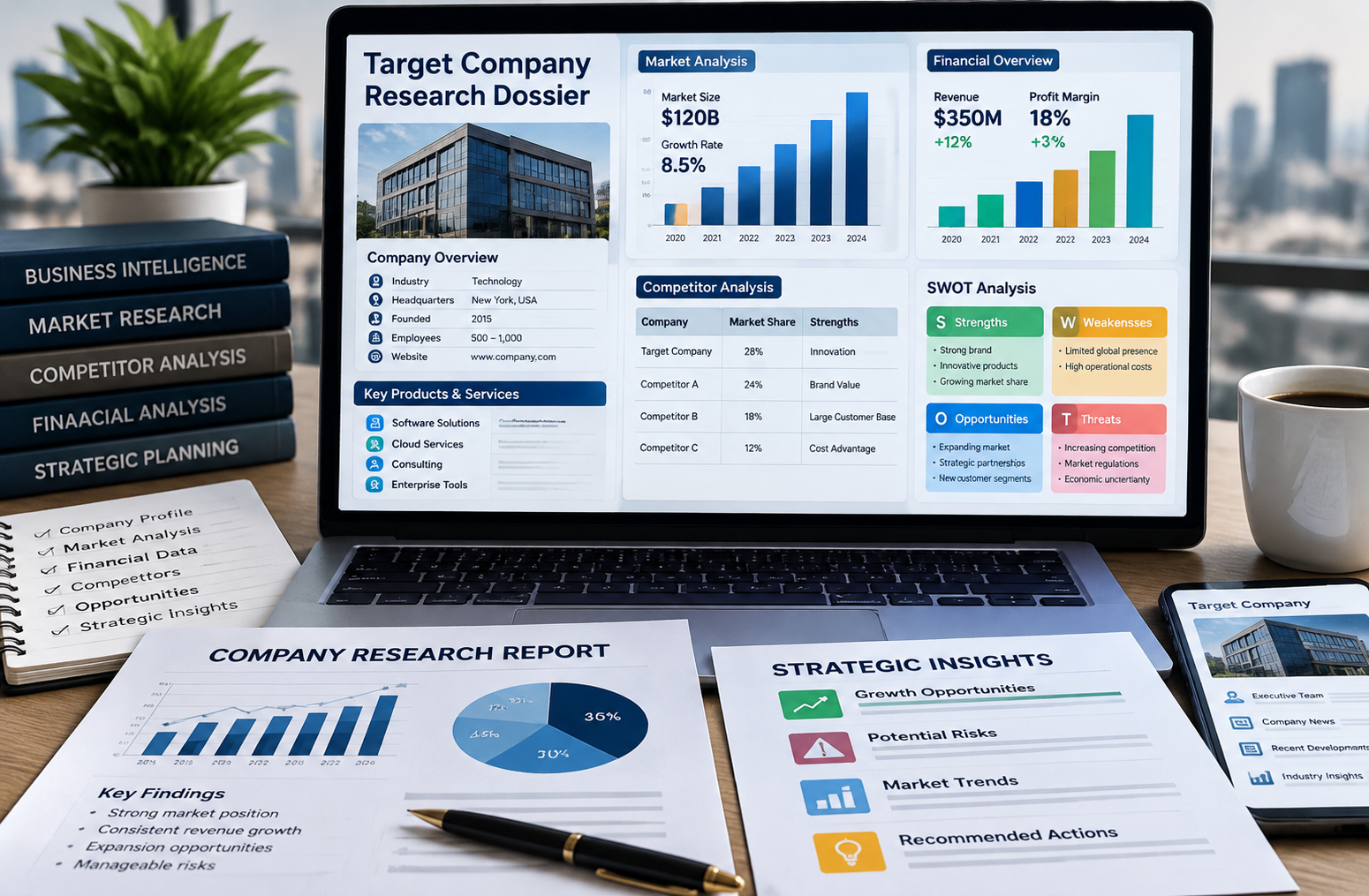
A research dossier for a target company is a detailed collection of information, analysis, and insights about a specific organization. It is created to understand a company’s background, operations, financial position, market presence, competitors, customers, opportunities, and potential risks.
Businesses, investors, sales teams, marketing agencies, and analysts use research dossiers to make informed decisions before investing, partnering, acquiring, or approaching another company.
Unlike a simple company profile, a research dossier goes deeper by combining factual information with strategic analysis. It answers important questions such as:
- What does the company do?
- Who are its customers?
- How strong is its market position?
- Who are its competitors?
- What opportunities exist?
- What risks should be considered?
A well-prepared target company research dossier works as a complete intelligence report that provides a 360-degree view of an organization.
Why Is a Target Company Research Dossier Important?
Modern business decisions require accurate information. Companies cannot rely only on basic website information or public descriptions when evaluating another organization.
A research dossier helps reduce uncertainty and provides valuable insights before making important decisions.
Some major reasons companies create research dossiers include:
Investment and Due Diligence
Investors use company research dossiers to evaluate whether a business is financially stable and has growth potential.
Before investing money, investors analyze:
- Revenue growth
- Funding history
- Leadership team
- Market demand
- Competitive advantage
- Business risks
A detailed dossier helps identify whether an opportunity is worth pursuing.
Sales and Business Development
Sales teams research target companies before contacting potential clients.
Understanding a company’s:
- Business model
- Current challenges
- Industry position
- Decision-makers
- Technology usage
allows sales professionals to create personalized outreach strategies.
Competitor Analysis
Businesses use research dossiers to study competitors and understand:
- Their strengths
- Their weaknesses
- Their pricing strategies
- Their marketing approach
- Their customer base
This information helps companies improve their own strategies.
Mergers and Acquisitions
During mergers and acquisitions, a research dossier becomes an essential part of the evaluation process.
Companies analyze:
- Financial performance
- Legal information
- Market position
- Operational structure
- Potential risks
before completing a deal.
What Information Is Included in a Research Dossier?
A professional target company research dossier usually includes multiple sections covering different aspects of the organization.
Company Overview
The first section provides basic company information.
It usually includes:
- Company name
- Website
- Industry
- Headquarters
- Founded year
- Company size
- Ownership type
- Mission and vision
This section creates a foundation for deeper analysis.
Company History and Background
Understanding a company’s history helps explain its current position.
Important information includes:
- Founding story
- Major milestones
- Product launches
- Expansion history
- Acquisitions
- Leadership changes
A company’s past performance often provides clues about future growth.
Products and Services Analysis
A research dossier should clearly explain what the company offers.
This section covers:
- Main products
- Services
- Pricing models
- Target customers
- Unique selling points
For example, a software company dossier may analyze its SaaS platform, subscription plans, integrations, and customer segments.
Business Model Analysis
Understanding how a company makes money is one of the most important parts of research.
A business model analysis examines:
- Revenue streams
- Pricing strategy
- Customer acquisition methods
- Distribution channels
- Partnerships
This helps determine whether the company has a sustainable business model.
Leadership and Management Research
A company’s leadership team strongly influences success.
A research dossier normally includes:
- Founders
- CEO
- Executives
- Board members
- Previous experience
Leadership analysis helps evaluate expertise, reputation, and decision-making capability.
Market Analysis
Market research shows where the company stands within its industry.
Important areas include:
- Industry size
- Market trends
- Growth opportunities
- Customer demand
- Industry challenges
A strong market analysis explains whether the company operates in a growing or declining market.
Competitor Analysis
Competitor research is a major part of any target company dossier.
It identifies:
- Direct competitors
- Indirect competitors
- Market alternatives
- Competitive advantages
A competitor analysis may compare:
| Area | Company | Competitors |
|---|---|---|
| Products | Main offerings | Alternative solutions |
| Pricing | Pricing model | Market pricing |
| Customers | Target audience | Customer segments |
| Marketing | Channels used | Marketing strategies |
This helps identify market gaps and opportunities.
Financial Research
Financial information provides insight into company performance.
Depending on availability, a dossier may include:
- Revenue estimates
- Funding rounds
- Investment history
- Profitability
- Growth rate
- Valuation
For public companies, financial information is usually available through official reports.
For private companies, researchers may use:
- Investment databases
- Industry reports
- Company announcements
- Market research platforms
Technology and Digital Presence Analysis
Technology analysis is increasingly important, especially for online businesses.
This section may include:
- Website performance
- Technology stack
- Mobile experience
- Software platforms
- Digital tools
For SEO and marketing purposes, researchers analyze:
- Organic traffic
- Ranking keywords
- Content strategy
- Backlink profile
- Social media presence
Customer and Reputation Research
Understanding customer opinions provides valuable insights.
A dossier may analyze:
- Customer reviews
- Ratings
- Testimonials
- Complaints
- Brand reputation
Common sources include:
- Review platforms
- Social media
- Industry forums
- Customer feedback
How to Create a Research Dossier for a Target Company
Creating a professional dossier requires a structured research process.
Step 1: Define the Research Objective
First determine why you need the dossier.
Examples:
- Investment evaluation
- Sales prospecting
- Competitor research
- Partnership opportunity
- Market analysis
The objective determines what information matters most.
Step 2: Collect Company Information
Start with reliable sources:
- Official website
- Company reports
- Industry publications
- Government databases
- Business directories
Always verify important information using multiple sources.
Step 3: Analyze Business Operations
Study:
- Products
- Customers
- Revenue model
- Marketing strategy
- Partnerships
This reveals how the company operates.
Step 4: Research Competitors
Identify companies competing in the same market.
Analyze:
- Their positioning
- Strengths
- Weaknesses
- Marketing activities
Step 5: Create Strategic Insights
The final stage is turning information into actionable insights.
A good dossier should answer:
- What opportunities exist?
- What risks are present?
- How strong is the company?
- What actions should be taken?
Tools Used for Creating Company Research Dossiers
Professionals use different tools depending on their research goals.
Common tools include:
Business Intelligence Tools
Used for company data and market research:
- Crunchbase
- PitchBook
- Similar business databases
SEO Research Tools
Used for digital analysis:
- Ahrefs
- Semrush
- Google Search Console
Website Analysis Tools
Used for technical evaluation:
- BuiltWith
- Similarweb
- PageSpeed Insights
Financial Research Platforms
Used for financial information:
- Company filings
- Investor reports
- Market databases
Benefits of Creating a Research Dossier
A detailed company dossier provides several advantages:
Better Decision Making
Reliable information helps businesses make smarter decisions.
Reduced Business Risk
Research identifies possible problems before major commitments.
Improved Sales Strategies
Understanding prospects allows personalized communication.
Competitive Advantage
Market insights help companies outperform competitors.
Better Investment Evaluation
Investors can identify valuable opportunities.
Challenges of Company Research Dossiers
Although useful, creating accurate dossiers has challenges.
Limited Public Information
Private companies may not disclose detailed financial information.
Data Accuracy Issues
Online information may be outdated or incorrect.
Time-Consuming Research
Collecting and analyzing information requires significant effort.
Rapid Market Changes
Industries can change quickly, making old information less useful.
Who Uses Research Dossiers?
Research dossiers are commonly used by:
- Investors
- Business analysts
- Marketing agencies
- Sales teams
- Consultants
- Entrepreneurs
- Corporate strategy teams
- Journalists
Any professional who needs a deeper understanding of a company can benefit from this type of research.
Research Dossier vs Company Profile
Many people confuse a company profile with a research dossier.
A company profile provides basic information such as:
- Company history
- Products
- Services
- Contact details
A research dossier provides deeper analysis including:
- Market position
- Financial evaluation
- Competitor research
- Risks
- Opportunities
- Strategic recommendations
A dossier is more detailed and decision-focused.
Frequently Asked Questions
What is included in a research dossier for a target company?
A research dossier usually includes company background, products, services, leadership information, financial data, competitors, market analysis, customer insights, and strategic opportunities.
Why do companies create research dossiers?
Companies create research dossiers to understand potential investments, competitors, customers, partners, and business opportunities before making decisions.
How long does it take to create a company research dossier?
The time depends on the company size and research depth. A basic dossier may take a few hours, while detailed due diligence reports can take weeks.
What is the difference between company research and a research dossier?
Company research collects information, while a research dossier organizes that information into a structured analysis with insights and recommendations.
Can a research dossier help with SEO analysis?
Yes. SEO professionals use company dossiers to analyze competitors, keywords, content strategies, backlinks, and online visibility.
Conclusion
A research dossier for a target company is a powerful tool for understanding businesses before making strategic decisions. It combines company information, market research, competitor analysis, financial insights, and operational details into one organized report.
Whether used for investment, sales, partnerships, competitor analysis, or SEO strategy, a well-created dossier provides valuable insights and reduces uncertainty.
The most effective research dossiers are not just collections of facts. They transform information into actionable intelligence that helps businesses identify opportunities, avoid risks, and make better decisions.